Halloween Ghost with Black Cat SVG
A Designer’s First Look: Playful, Not Precious
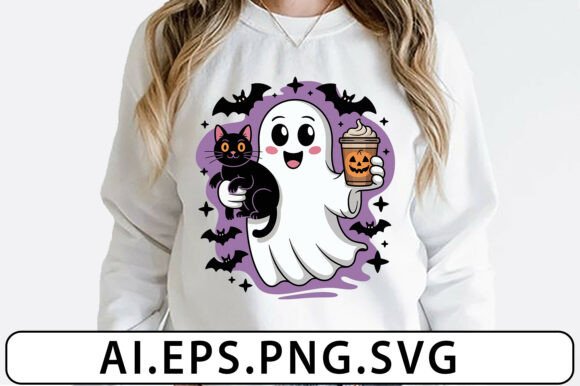
When I opened Halloween Ghost with Black Cat SVG, my first thought wasn’t “cute” or “spooky”—it was “workable.” The ghost leans slightly left, arms raised in a friendly float, while the black cat curls beneath it like a shadow given shape. There’s no fussy detailing—no tiny whiskers, no intricate paw pads, no layered eyes—just clean, confident outlines and balanced negative space. That’s not a flaw; it’s intention. This isn’t a design built for gallery embroidery. It’s built for real life: quick digitizing, forgiving stitch execution, and immediate recognition at a glance.
Where It Shines (and Where It Doesn’t Pretend To)
I recently used Halloween Ghost with Black Cat SVG as the centerpiece for a custom embroidered tote bag—linen-cotton blend, medium weight, light charcoal. Paired with soft black thread and a light tear-away stabilizer, it stitched cleanly in under 90 seconds. The curves held well, the cat’s tail didn’t pull, and the ghost’s rounded edges stayed smooth—not jagged, not pixelated. That’s the quiet strength of this design: it assumes you’ll be stitching on real fabric, not vector artboards.
It works beautifully on sweatshirt embroidery—especially crewnecks and hoodies—where bold, legible shapes read even from across a room. On baby embroidery? Yes—but only on items like cotton onesies or burp cloths where stitch density won’t overwhelm delicate fabric. Avoid it on ultra-thin tees or stretchy performance knits unless you add cut-away stabilizer and reduce stitch density manually. The design doesn’t include built-in underlay or pull compensation, so those adjustments fall to you.
Real-World Fit: More Than Just a T-Shirt Design
Calling this a T-Shirt Design undersells it. As a craft business owner, I’ve seen how often this motif lands on aprons for bakery pop-ups, pillow covers for Halloween-themed nurseries, and tea towels sold at local craft fairs. Its simplicity makes it scale-friendly: enlarge it for a blanket corner or shrink it down for a cap front—just confirm your hoop size first. For caps specifically, test the ghost’s top curve on scrap fabric; some versions of this design push too close to the bill seam, risking skipped stitches.
It also holds up well in digital embroidery file previews and printable mockups. Because it’s vector-based and print-ready, I dropped it straight into a mockup template for an Etsy listing—no distortion, no re-tracing. Buyers responded quickly to the clean silhouette and clear holiday theme. That visual clarity translates directly to buyer engagement: people know what they’re getting before they click “Add to Cart.”
What to Watch For Before You Stitch
- Test on scrap fabric first—especially if using textured fabrics like terry cloth or burlap, where fill stitch can sink or blur.
- Check thread color contrast on both light and dark backgrounds. Black thread on navy feels rich; on charcoal, it can fade visually. Try charcoal thread instead.
- Review stitch density. Some versions run dense in the ghost’s body—fine for stable fabrics, risky on lightweight cotton. Lighten fill stitch by 15–20% if needed.
- Inspect small details before sending to machine. The cat’s ear tip and ghost’s bottom curve are subtle—if digitized poorly, they may stitch as thin lines or vanish entirely.
- Use proper stabilizer: light tear-away for stable wovens, cut-away for knits or baby items. Skip fusible web unless you’re doing applique design—this isn’t built for that workflow.
- Confirm licensing before selling finished products or reselling the digital embroidery file. The description says “use it in your print item without any issues,” but commercial embroidery rights aren’t always included by default—verify before scaling your craft business.
Why It Builds Trust—Not Just Stitches
Customers don’t buy embroidery files—they buy confidence. When someone orders a personalized gift with Halloween Ghost with Black Cat SVG, they’re trusting that it will land with charm and craftsmanship. And it does—because the design avoids overcomplication. No one squints at a tiny satin stitch eye wondering if it’s supposed to look like that. No one questions whether the ghost is floating or falling. It reads instantly, stitches reliably, and feels handmade—not mass-produced.
That consistency matters for brand-building. If you sell small shop products under a cohesive seasonal line—say, “Spook & Stitch” autumn collections—this design slots right in. It pairs naturally with simple pumpkins or bats, never competes for attention, and reinforces a warm, approachable aesthetic. It’s not trying to be avant-garde. It’s trying to be dependable.
Final Thought: A Quietly Smart Choice
Halloween Ghost with Black Cat SVG won’t win awards for technical complexity—but then again, neither do most best-selling embroidery projects. What it delivers is something rarer in the digital embroidery file world: thoughtful restraint. It respects your time, your machine, your fabric, and your customer’s expectations. Whether you’re prepping a batch of embroidered patches for a boutique launch, adding holiday flair to kitchen towels, or building your first Etsy store around custom apparel, this design earns its place in your library—not as filler, but as foundation.
Just remember: great embroidery starts long before the needle drops. Check your hoop size. Test on fabric. Confirm the license. Then let the ghost float—and the cat curl—exactly where they belong.