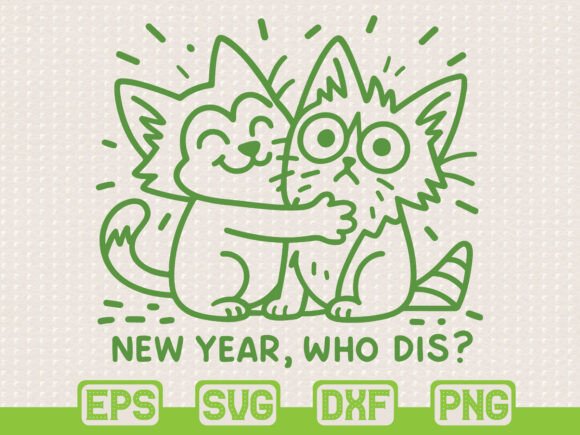
New Year Who Dis Cat SVG
First Impressions: Playful, Punchy, and Perfectly Timed
When I opened New Year Who Dis Cat SVG, I smiled—not because it’s “cute,” but because it lands with confident, dry wit. The cat’s deadpan expression, slightly slumped posture, and the bold, uneven lettering of “Who Dis?” instantly communicate a shared cultural sigh at midnight countdowns. It’s not chaotic; it’s curated chaos. As a designer who’s stitched hundreds of holiday motifs—from glittery snowflakes to overly earnest “Happy New Year!” scripts—this one stands out for its restraint and personality. The layout is compact but breathing, with clear negative space around the cat’s outline and text. That matters. A lot. In embroidery, empty space isn’t wasted—it’s where your stitches settle, where fabric relaxes, and where readability survives.
What This Design *Wants* to Be Embroidered On
I tested New Year Who Dis Cat SVG as a machine embroidery design on a natural cotton tote bag for a local boutique’s New Year’s Eve pop-up. Why a tote? Because it’s unforgiving: medium-weight fabric, no stretch, visible seams, and high customer scrutiny. The result? Sharp. The cat’s outline held crisp satin stitch definition, and the phrase “Who Dis?” stayed legible even at 3.5 inches wide—no fuzzy edges or thread pooling. It also worked beautifully as an embroidered patch sewn onto a denim jacket sleeve and as subtle sweatshirt embroidery centered just above the left pocket. Its energy fits relaxed, lifestyle-driven products—not formal wear or corporate swag. Think baby onesies (paired with soft pastel thread), tea towels for a quirky kitchen brand, pillow covers for a millennial nursery, or aprons for a cocktail bar’s staff. It’s not “holiday decor” in the traditional sense; it’s *attitude*, stitched.
Where It Shines—and Where You’ll Need Extra Care
New Year Who Dis Cat SVG thrives on stable, medium-to-heavy fabrics: canvas, twill, fleece-backed sweatshirts, linen-blend tea towels, and structured caps. On those, the design’s balanced weight distribution prevents puckering, and its moderate stitch density avoids stiffness. But caution applies in three real-world cases:
- Thin or stretchy fabric: T-shirt knits and lightweight rayon will need cutaway stabilizer *and* a topping—especially under the “Who Dis?” text. Without it, those short, angular letters can distort or sink.
- Curved or layered surfaces: Caps work—but only if you use a low-profile hoop and reduce stitch density slightly in the crown curve. Avoid placing it across shoulder seams or elbow bends unless you’re willing to split the design.
- Dark or textured backgrounds: The design relies on contrast. On charcoal terry cloth or bouclé knit, test thread colors first. Light gray or heathered thread may disappear; off-white or pale gold pops better than stark white.
How It Shapes Customer Perception—Before They Even Touch It
Embroidery isn’t just decoration—it’s a trust signal. When someone sees clean, confident stitching on a handmade product, they assume care, skill, and intention. New Year Who Dis Cat SVG delivers that—if executed well. Its humor feels authentic, not algorithm-chosen, which resonates with Etsy shoppers and craft-fair buyers who scroll past generic slogans. I’ve seen customers pause mid-browse, point, and laugh—then buy two. That emotional hook boosts giftability, especially for personalized New Year’s gifts (“For my friend who definitely skipped the party”). It also supports brand consistency for small shops leaning into witty, relatable voice—think a boutique coffee roaster adding it to aprons or a parenting blog selling embroidered baby blankets.
Practical Designer Notes Before You Stitch
Before committing to a batch run or listing on your shop:
- Run a test on scrap fabric *identical* to your final product—same weave, weight, and pre-wash status.
- Check thread color contrast in both daylight and indoor lighting. What reads clearly on screen may blur on fabric.
- Review stitch density in your embroidery software. If fill areas feel heavy, reduce density by 5–8%—especially for baby items or lightweight garments.
- Confirm hoop size compatibility. This design fits comfortably in a 4x4 hoop, but verify before hooping delicate items like caps or curved pillow covers.
- Inspect tiny details: the cat’s ear tip, the dot over the “i” in “Dis.” Are they defined enough for your chosen thread weight? If not, adjust pull compensation or add a tiny running stitch accent.
- Test black-and-white mockups. Does the silhouette hold up without color? It should—this design’s strength is shape-first storytelling.
- Use tear-away stabilizer for stable fabrics, cutaway for knits or stretchy blends. Skip the “magic” spray-on stabilizers—they rarely hold up through washing.
- Verify licensing terms. Since this is marketed for POD platforms like Merch by Amazon and Redbubble, confirm whether the license permits commercial embroidery use—especially for physical finished products sold outside those platforms.
Final Thought: Not Just a Graphic—A Conversation Starter
New Year Who Dis Cat SVG isn’t a “safe” choice—and that’s why it works. It won’t blend in. It invites reaction, shares a wink, and holds up under repeated wear and wash when stitched thoughtfully. As a T-Shirt Design and Graphics asset, it bridges digital ease and tactile charm. For embroidery designers, it’s a refreshingly human counterpoint to over-polished clipart. For Etsy sellers and small shop owners, it’s a low-risk, high-engagement addition to holiday collections—especially when paired with strong photography showing real texture, real stitching, and real smiles. Just remember: great embroidery starts long before the needle drops. It starts with knowing what the design asks of you—and answering honestly.